Dominik Schön
XR Researcher & Developer
I am an XR researcher at the Telecooperation Lab at TU Darmstadt. My work focuses on the ergonomics of Extended Reality environments.
If you'd like to get in touch, feel free to .
XR Researcher & Developer
I am an XR researcher at the Telecooperation Lab at TU Darmstadt. My work focuses on the ergonomics of Extended Reality environments.
If you'd like to get in touch, feel free to .

Explore my first-author publications, primarily on Ergonomic-aware Extended Realities, where I investigate the intersection of technology and user comfort.

Recreational athletes increasingly adopt quantified-self practices to track and advance their training, recovery, and fitness. Blood lactate is a key biomarker in this context, but testing remains invasive and costly, limiting its use to professional sports and clinics. For everyday exercisers, even a coarse distinction, such as whether they are training below or above key thresholds, already provides actionable insight. We investigate whether commodity smartphones can classify these thresholds non-invasively using swipe input and built-in sensors. In a data-collection study, participants completed touchscreen tracing tasks at varying physiological states during their workout, while collecting blood samples. We analyzed touch, pressure, motion, and task features to understand their role in classifying the Energy Metabolism and Lactate Accumulation Zones and trained a Support Vector Machine and a Recurrent Neural Network. Our results demonstrate the feasibility of estimating these zones from short smartphone interactions, suggesting a path toward accessible, non-invasive on-device training guidance. Proceedings of Augmented Humans International Conference 2026 (AHs 2026), 2026, 10.1145/3795011.3795043

The degrees of freedom of our arms allow us to easily translate and rotate our hands in front of our bodies. As such, most of the common mid-air input in Extended Reality (XR) builds on these two 3D transforms. However, current research primarily focuses on specific forms and expressions of mid-air input, thereby not providing insights into the comfort and performance of the two gestural primitive building blocks: rotation and translation. To design ergonomic mid-air XR gesture input, we need a thorough understanding of the comfort and performance intrinsic to these two ground-laying building blocks. In this work, we investigate the effects of multiple influences of gestural input, such as interaction placement and complexity, on perceived comfort and performance. Our results reveal comfort preferences for translational interaction, while also highlighting opportunities for rotational-based input. We discuss how these findings can guide designers in creating more comfortable XR experiences and situate our findings within previous work. Proceedings of Augmented Humans International Conference 2026 (AHs 2026), 2026, 10.1145/3795011.3795044

User interaction with digital systems requires Fine Motor Control (FMC), especially if the interfaces are complex or require high fidelity and fine-grained interactions. Despite its importance, Fine Motor Control is often overlooked in interactive system design, partly because of its complex assessment. Measuring changes in fine motor abilities due to prolonged use or fatigue currently requires repeated manual testing. This paper analyzes the concept of using the digital mobile devices' input behavior to assess the user's Fine Motor Control. For this, we show that Fine Motor Control can be assessed for touch and stylus-based interaction with a digital mobile system. We conducted a user study, where participants performed a Nine Hole Peg Test and a predefined Copy Drawing Test before and after exercises that affect fine motor skills. Based on this data, we investigated how metrics such as pressure, velocity, and entropy for touch and stylus input can be used to predict Fine Motor Control. Proceedings of ACM Hum.-Comput. Interact. 9, 5, Article MHCI012, 2025, 10.1145/3743714

This work explores how physical exertion can influence handwriting and drawing quality. We collected data from 17 participants and used machine learning to predict perceived exertion based on simple line drawings. Our findings suggest that interactive systems could use these insights to assist users when they experience discomfort during physical activity, although more research is needed for more complex drawings and handwriting. Proceedings of the International Conference on Mobile and Ubiquitous Multimedia 2024, 10.1145/3701571.3703393

VRow is a toolkit that makes it easier to integrate exercise equipment like rowers, bikes, and ski ergometers into Unity-based VR projects. It simplifies tasks such as connection handling and data parsing, allowing researchers to focus on using detailed ergometer data for logging and interactive experiences. VRow supports the creation of immersive exergames that blend fitness and entertainment, helping to advance engaging and effective physical activity solutions. Proceedings of the International Conference on Mobile and Ubiquitous Multimedia 2024, 10.1145/3626705.3631785
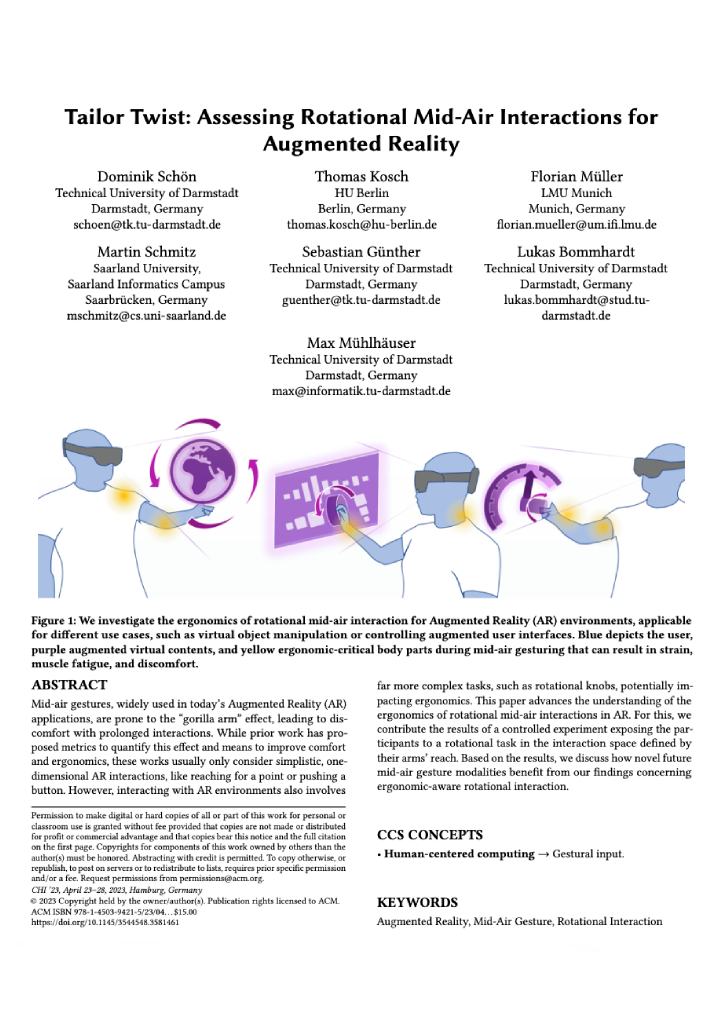
Mid-air gestures in Augmented Reality (AR) often cause discomfort during extended use due to the "gorilla arm" effect. While previous research has focused on simple interactions like pointing or button presses, this paper examines the ergonomics of more complex tasks, such as rotational gestures. We present findings from a controlled experiment exploring the impact of rotational tasks on user comfort within arm's reach. These insights pave the way for designing more ergonomic mid-air gesture modalities for future AR applications. Proceedings of the 2023 CHI Conference on Human Factors in Computing Systems, 10.1145/3544548.3581461

TrackItPipe is a fabrication pipeline that helps users add tracking capabilities to 3D printable objects without needing CAD expertise. It semi-automatically modifies 3D models to support precise position and rotation tracking, tailors the designs to environmental requirements, and generates integration scripts for Mixed Reality. With TrackItPipe, users can quickly create physical objects that seamlessly interact with virtual environments. Adjunct Proceedings of the 35th Annual ACM Symposium on User Interface Software and Technology, 10.1145/3526114.3558719
During my computer science studies and the subsequent PhD, I was involved in various small programming projects. Here is a selection of them.

My academic and professional journey combines a focus on computer science, sports, and hands-on programming experience.
High school graduation with a strong focus on computer science
Bachelor's degree with the thesis "HoloChess: Combining Mixed Reality and 3D-Printed Tangibles for Competitive Board Games Supporting Remote Located Players" and subsequent publication: CheckMate
Founder and Developer at PolyDev. Designing and implementing different sofware solutions.
Master's degree with the thesis "Supporting Cyclist Crossing Decision-making at Uncontrolled Intersections using Augmented Reality" and subsequent publication: BikeAR
Joining the Telecooperation Lab as a PhD student. Responsible for research, teaching and thesis supervision.
Joining and building up the newly founded Urban Interaction Lab as a PhD student. From 2024 on under supervision of Prof. Max Mühlhäuser (TK) and Prof. Florian Müller (Urban Interaction).